Exchange or Broker: CME Futures vs CFDs and Forex with a Market Maker
Before you start looking for an edge, check what market you are actually trading. The same Dow Jones chart can come from a regulated exchange with one central order book, or from a single broker's price feed. For an order flow trader, that's the difference between data and an imitation of it.
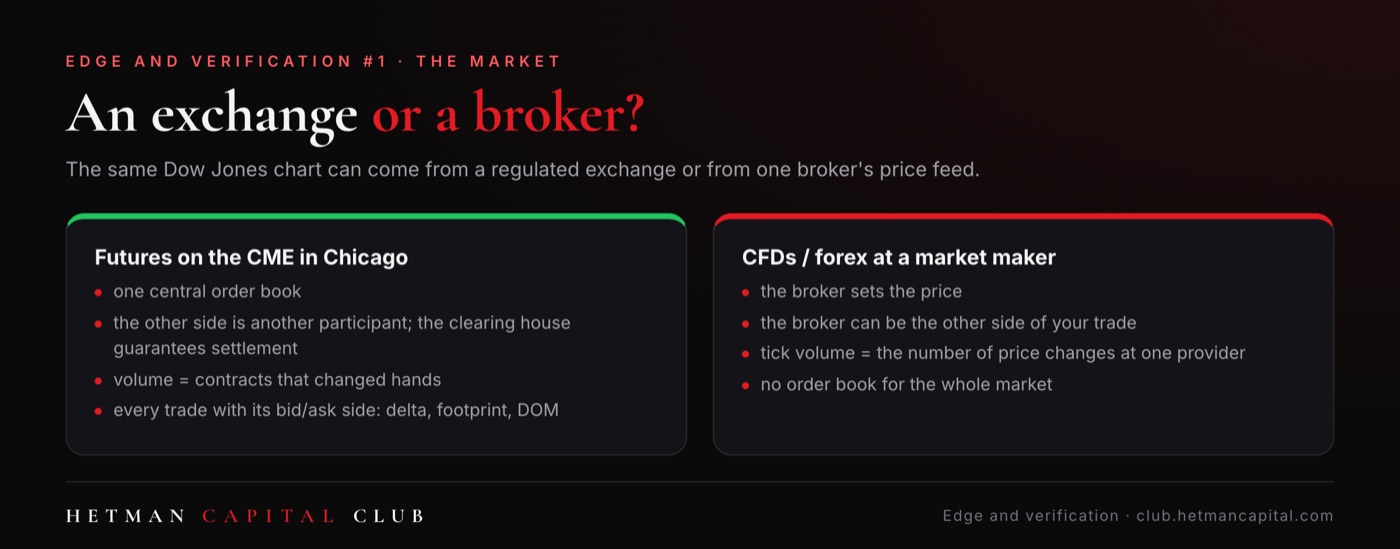
Two worlds under the same name
When someone says “I trade the Dow Jones”, they may mean two completely different things.
- A futures contract on the CME in Chicago (YM, MYM). All participants, from funds to retail traders, send their orders to one central order book. Price is formed where buyers and sellers meet. Every trade is recorded and appears in the exchange data.
- A CFD or an “index” with a forex broker. You buy a contract with the broker, who quotes the price himself, based on the underlying market. Your order never reaches an exchange. The broker may pass it on, but may also be the counterparty to your trade himself.
Who is on the other side
On an exchange, the other side is another market participant, and the clearing house guarantees the settlement of every trade. With a market-maker (dealing desk) broker, the other side is often the broker itself. That doesn't have to mean fraud, but it creates a conflict of interest: your loss can be its profit. On top of that the broker sets the spread, commissions and swaps, and in volatile moments it can widen the spread or change order conditions.
What this means for the data
This is the crux of the matter for order flow.
- Volume. On the CME, volume is the number of contracts that actually changed hands. In spot forex and CFDs, the platform usually shows tick volume – the number of price changes at one provider. It's a proxy for activity, not a count of contracts.
- The order book. The DOM on the CME shows the whole market's limit orders at the best prices. A CFD broker has no order book for the whole market, because there is no single market.
- Delta and the footprint. To know whether a trade was an aggressive buy or sell, you need a record of every trade with its bid or ask side. That data comes from the exchange, not from a broker's price feed.
That's why I pay for CME exchange data, trade by trade, and work in Sierra Chart. All the numbers, charts and statistics in this section come from actual trading.
Costs and access
Futures are not “for institutions only”. The micro contract (MYM) is worth $0.50 per point, so a 100-point move is $50 per contract. You pay for access differently than with a CFD broker: a commission per contract, exchange fees and a data subscription instead of a spread built into the price. To start, you also need to understand how margin and daily settlement work (📖 Trader's Glossary).
When CFDs make sense and when they don't
CFDs can be convenient for small-scale investing or for markets that are hard to access. But if you are learning to read order flow, you need a market where that flow is real and visible. Learning order flow on broker data is like learning to read music from a score someone has rewritten their own way.
Five questions about your market access
- Do my orders go to an exchange or to a broker?
- Who is the counterparty to my trades?
- Is the volume on my chart contracts or price changes?
- Can I see the whole market's order book?
- How much do I really pay per trade, including the spread?
Exercise
Open a chart of your instrument and answer the five questions above. If you don't know the answer to three of them, start by checking the terms and the instrument specification before you begin analysing the chart.
Educational content, not investment advice. No signals, entries or position sizes.