MYM contracts and rollover: what you need to know about expiration
Unlike stocks, futures contracts have an expiration date. For an MYM trader that means four times a year when you have to move to a new contract month. It's simple, but not knowing the rules can be costly: from trading an illiquid contract to wrong levels on your chart.
MYM basics
- MYM is the micro futures contract on the Dow Jones Industrial Average, listed on the CME (CBOT).
- One index point is worth $0.50, and the minimum price increment is 1 point.
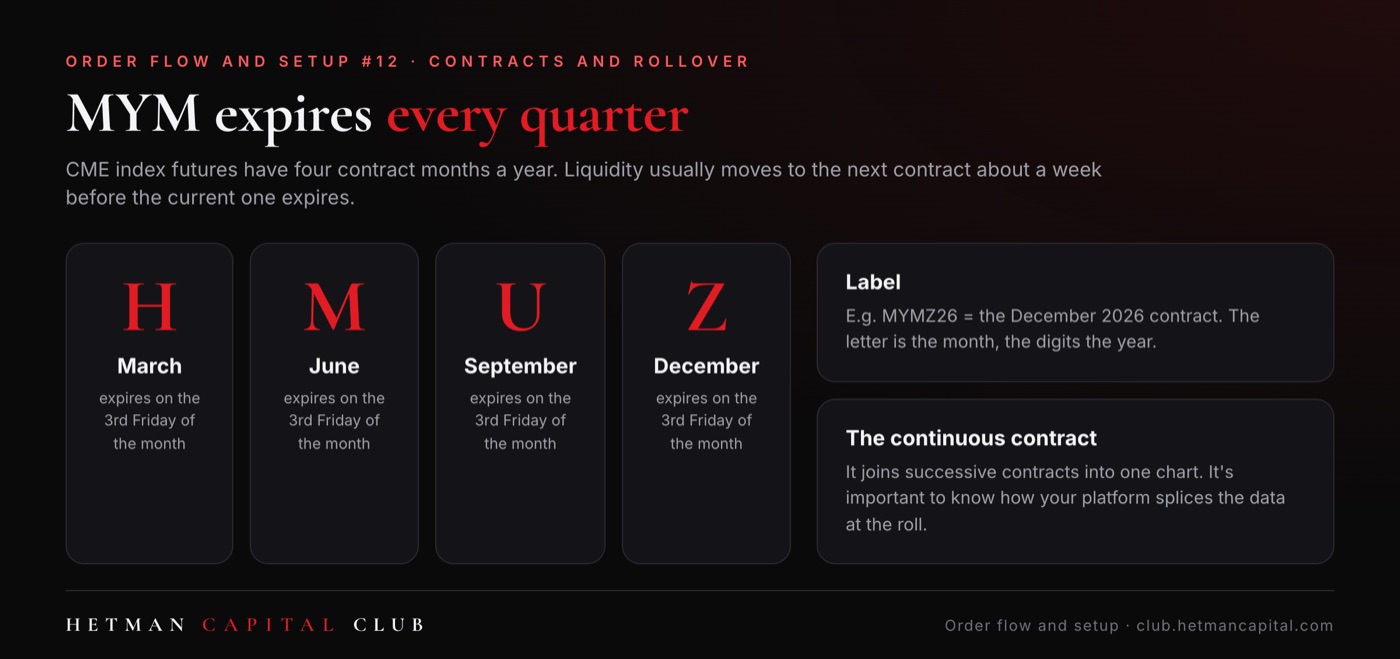
- The contract has four expirations a year: H (March), M (June), U (September), Z (December).
- A symbol such as MYMZ26 is the December 2026 contract.
Expiration and rollover
- A contract expires on the third Friday of the contract month.
- Liquidity rolls to the next contract usually about a week before expiration. From then on most participants trade the new contract.
- After the roll, the old contract has lower volume and wider spreads.
- Check the exact dates in the contract specifications on the CME website or with your broker.
The continuous contract
Charts often use a continuous contract that joins successive contracts into one data series. Important questions:
- When does the platform switch contracts? By date or by volume?
- Is the price difference between contracts adjusted? Successive contracts trade at different prices. Without adjustment, an artificial gap appears on the chart and levels from the previous period may be shifted.
- Which contract are the levels calculated from? A monthly profile or long-period moving averages can look different on the continuous contract and on a single contract month.
In my analytical system, longer-period levels are calculated on the continuous contract, taking the liquidity roll into account, so that they match what you see on the chart.
Rollover week checklist
- Check the expiration date of the current contract.
- Watch for when the new contract's volume exceeds the old one's.
- Update the symbol on all charts and in your order entry platform.
- Check that the continuous contract and the longer-period levels are correct.
- Make sure you have no working orders left on the old contract.
Exercise
Check how the continuous contract is defined in your platform: when it switches contracts and whether it adjusts for the price difference. If you don't know, ask in ❓ Ask Lucas.
Educational content, not investment advice. No signals, entries or position sizes.