A Trading Journal That Teaches: Structure, Tags and Review
A trading journal is a trader's cheapest and most effective development tool – and the most often neglected. Most journals are just a list of results. A journal that teaches is a database of your decisions from which, after a few weeks, you draw concrete conclusions about your process.
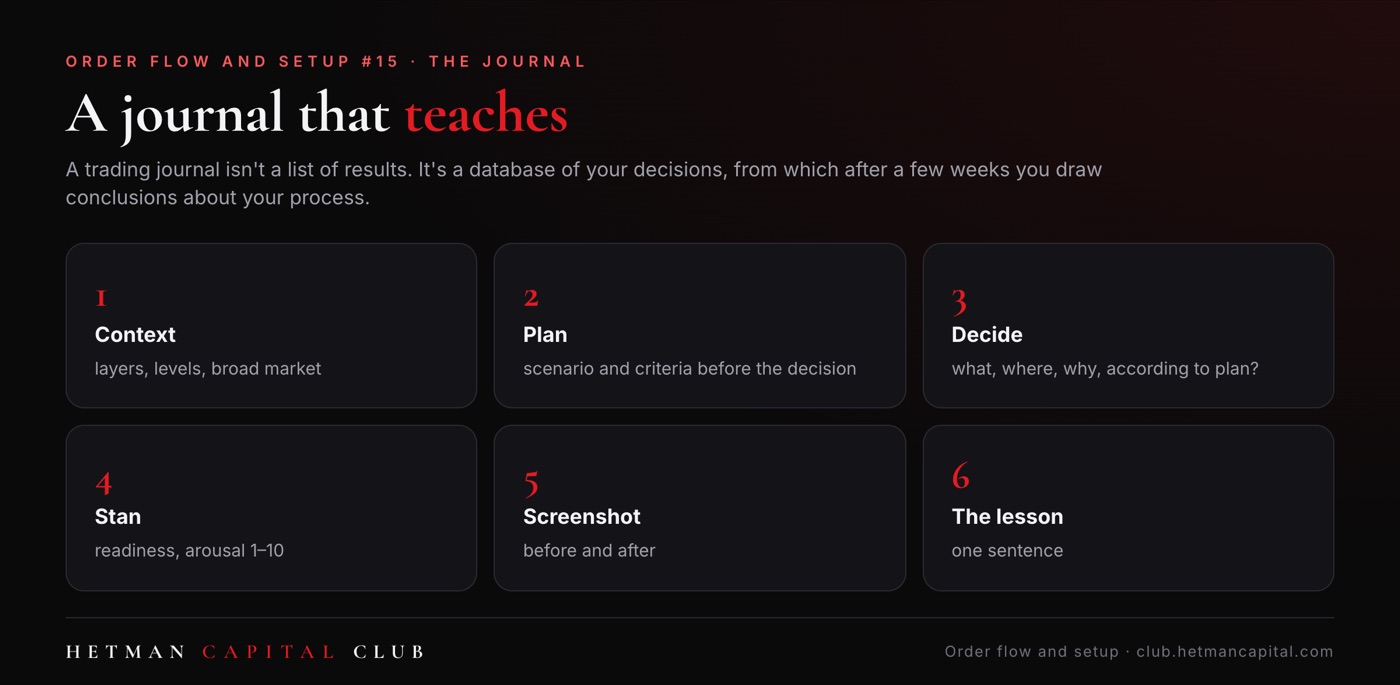
Six fields in every entry
- Context: what layer the market was in, which levels were nearby, how the broad market was behaving (articles #2 and #4).
- Plan: what scenario and criteria you had before the decision.
- Decision: what you did, where and why. Was it in line with the plan?
- State: your readiness and arousal on a 1–10 scale (the 🧘 Trader's Body and Mind space).
- Screenshot: before and after the decision. A picture remembers more than words.
- Lesson: one sentence.
Tags
Add short tags to your entries, e.g. the type of situation, the day type (article #11), “in plan” or “off plan”, “before macro data”. After a month you can filter your entries and see which situations you handle best and worst, and in what state you make the most mistakes.
The weekly review
Once a week, within a fixed time box:
- How many decisions were in line with the plan?
- Which tags keep recurring in off-plan decisions?
- How does your state (sleep, arousal) relate to the quality of your decisions?
- One change to your process for the following week.
The tool
It doesn't matter whether you keep your journal in a spreadsheet, an app or a notebook. What counts is regularity and honesty. The best journal is the one you actually fill in after every session.
The most common mistakes
- recording only results
- filling in the journal “when there's time” – in other words, rarely
- editing entries after the fact
- no review: data nobody analyses teaches nothing
How we use the journal in the Club
You can post parts of your journal – especially screenshots with a description of the context and the decision – to 🔍 Your chart for review. It's the best material for analysing your process together.
Exercise
Prepare a template with the six fields and fill it in after every session for 2 weeks. At the end, do your first review and post one lesson to 🏆 Wins and lessons.
Educational content, not investment advice. No signals, entries or position sizes.