Prop firm or your own account?
Prop trading firms have become very popular, especially among futures traders. I don't recommend any particular firm or model. Below are the criteria that help you make your own decision.
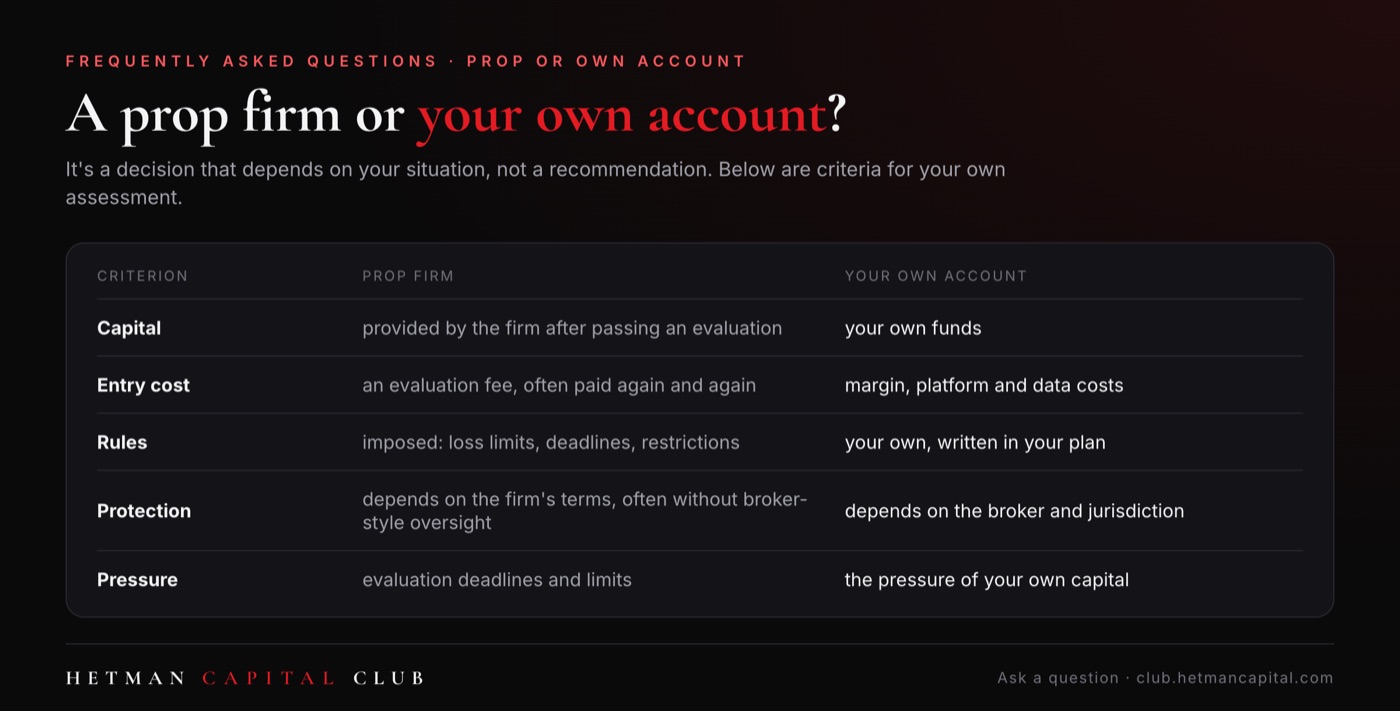
How they compare
- Capital: in the prop model the firm provides it after you pass the evaluation; in your own account it's your money.
- Cost of entry: with a prop firm, the evaluation fee, often paid again after a failed attempt. In your own account, the margin deposit plus platform and data costs.
- Rules: with a prop firm, imposed loss limits, deadlines and restrictions, for example on trading during data releases. In your own account, the rules from your own plan.
- Protection: with a prop firm it depends on the firm's terms, and the firm is often not supervised the way a broker is. In your own account it depends on the broker and the jurisdiction.
- Pressure: evaluation deadlines and limits versus the pressure of risking your own capital.
What to check in a prop firm's terms
- how drawdown is calculated (e.g. static or trailing)
- payout conditions and the profit split
- the list of prohibited practices and trading times
- what happens to the account if you break a rule
The common rule
Whatever you choose, the process is the same: a plan, a journal, managing your state and consistency. A prop firm won't replace skill, and its limits demand even more discipline.
More in the 📖 Trader's Glossary: Prop trading firm.
Educational content, not financial, legal or tax advice.