1:1000 leverage: simple maths, the rules and what the ads don't tell you

Someone on my live stream was praising 1:1000 leverage. It sounds like a bargain: you deposit $100 and trade $100,000. Before anyone gets tempted, it's worth working out what that means in practice. The maths here is simpler than in any strategy, and it decides how long the account survives.
What leverage is
Leverage is the ratio of the position's value to the money securing it (the margin). At 1:1000, a $100 margin opens a position worth $100,000. Profit and loss are calculated on the full $100,000, not on your $100. Leverage doesn't change the market – only how hard each price move hits your account.
How far price has to move to wipe out the margin
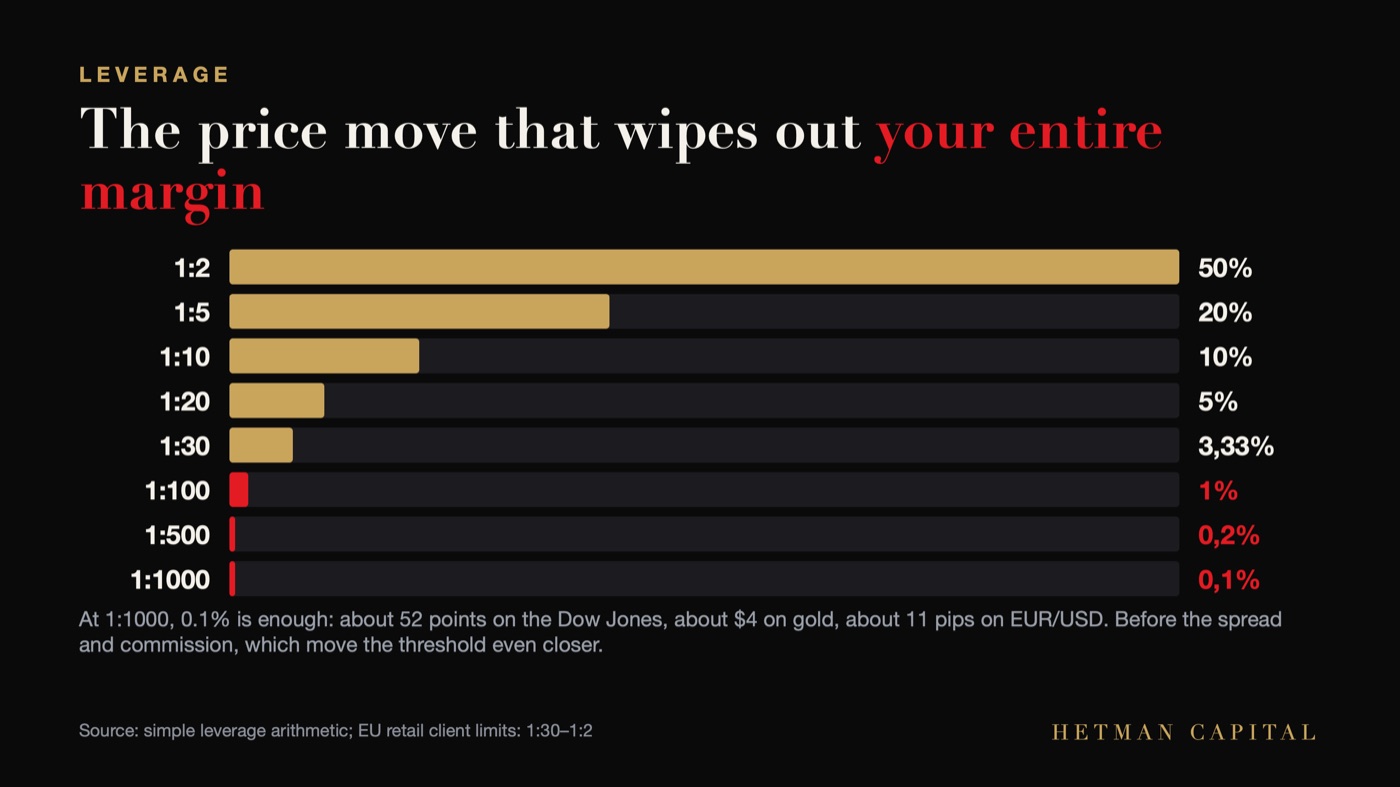
The adverse price move that wipes out the whole margin is roughly 1 divided by the leverage (before the spread, commissions and fees, which bring that threshold even closer):
| Leverage | Price move that wipes out the margin |
|---|---|
| 1:2 | 50% |
| 1:5 | 20% |
| 1:10 | 10% |
| 1:20 | 5% |
| 1:30 | 3,33% |
| 1:100 | 1% |
| 1:500 | 0,2% |
| 1:1000 | 0,1% |
At 1:1000 a move of just 0.1% is enough. For comparison, at current prices:
- EUR/USD (about 1.12): 0.1% is about 11 pips. A currency pair makes that move within minutes, and within seconds during a macro release.
- Gold (about $4,175 an ounce): 0.1% is about $4.
- Dow Jones (about 52,500 points): 0.1% is about 52 points. On Thursday, October 15, 2026 the Dow Jones rose 556 points in one session (about 1.1%), and overnight from October 15 to 16 the contract's range was 215 points (about 0.4%).
At 1:1000, ordinary market noise is enough to close the position with the loss of the entire margin before the market even moves in the direction you expected. You can be right about the direction and the account still won't survive the journey.
The limits in the EU and in Poland
Since 2018, restrictions on CFDs for retail clients have applied across the EU. ESMA introduced them first, and since August 1, 2019 a KNF resolution has written them into Polish rules:
| CFD underlying | Maximum leverage (retail client) |
|---|---|
| major currency pairs | 1:30 |
| other currency pairs, gold, major indices | 1:20 |
| other commodities, other indices | 1:10 |
| individual stocks | 1:5 |
| crypto | 1:2 |
- Negative balance protection: a retail client can't lose more than they have in the account.
- Automatic close-out when the account equity falls below a set level of the required margin (50% under the ESMA rules).
- A ban on bonuses that encourage trading, and a mandatory warning showing the share of clients who lose.
- In Poland the KNF also created the status of an experienced retail client (requiring, among other things, documented training), to whom Polish brokerage houses may offer higher leverage on selected instruments.
So where does 1:1000 come from
Leverage of 1:1000 and higher is offered by two groups:
- Non-EU brokers, often registered in countries with lax supervision. A client from the EU then loses EU (and national) protection: leverage limits, often negative balance protection, complaints handled by a domestic supervisor. If such a firm actively offers services in Poland without a licence, it may end up on the KNF public warning list.
- EU brokers, for professional clients. Professional status requires meeting two of three conditions (a portfolio above €500,000, an average of 10 significant-size trades per quarter over the past year, at least a year of work in the financial sector) plus a knowledge assessment by the firm. A professional client gives up the leverage limits and, according to the French regulator AMF, can lose more than the account balance.
Why would a broker advertise high leverage at all? Because higher leverage means bigger positions, and bigger positions mean more spread and commission paid. At a broker that is the counterparty to the client's trades (the market-maker model), the client's loss can be the firm's revenue directly. According to the Polish regulator (UKNF), 72.2% of active forex and CFD clients lost money in 2025.
Leverage on a futures exchange: honestly
Futures have leverage too, and I have to say so plainly, because I trade them myself. One Micro Dow Jones contract (MYM) is $0.50 per point, so at around 52,500 points it's a position worth about $26,250. Margin is set by the exchange (CME Group) and the broker, and some brokers' day-trading margin is far lower than the exchange margin. In that case the leverage you can open is also very high.
That's why what matters more than the leverage a broker offers is the leverage you actually use: the position value divided by your total account equity. An example using Thursday's 556-point move ($278 on one MYM contract):
| Account equity | Effective leverage (1 MYM) | A 556-point move against the position |
|---|---|---|
| $26,250 | 1:1 | −1.1% of the account |
| $2,625 | 1:10 | −10.6% of the account |
| $525 | 1:50 | −53% of the account |
| $262 | 1:100 | more than 100% of the account |
This illustrates the maths; it's not a suggestion for position size. The difference between an exchange and a CFD lies elsewhere: on an exchange you see one central order book and real volume, and the price comes from all participants' trades. You set your leverage yourself anyway, through your position size relative to your account. I write more about this difference in the article Exchange or CFD broker.
How to recognise the leverage trap
- The ad talks about leverage, not risk: “trade $100k with $100”.
- The broker isn't in the registers of the KNF or any EU regulator, yet the website has a local-language version and a local “account manager”.
- Someone urges you to apply for professional client status “to unlock leverage”. ESMA considers such inducements impermissible.
- The person recommending leverage earns from your trading volume: a broker affiliate link, a signals group (I describe this in the article Gold signals).
Frequently asked questions
What does 1:1000 leverage mean?
That a $100 margin opens a position worth $100,000. A 0.1% price move against the position then wipes out the whole margin, even before the spread and commission.
What is the maximum leverage in Poland?
For a retail CFD client: 1:30 on major currency pairs, 1:20 on gold and major indices, 1:10 on other commodities, 1:5 on stocks and 1:2 on crypto. In Poland this applies under a 2019 KNF resolution. Higher limits apply to professional clients and, in Poland, to experienced retail clients.
Is 1:1000 leverage legal?
In the EU a broker can't offer it to a retail CFD client. It's offered by non-EU brokers, or by EU firms to professional clients. If you use a non-EU broker, you lose the protection of EU and national rules.
Do futures have leverage too?
Yes. The Micro Dow Jones contract (MYM) is a position worth about $26,000 at 52,500 points, and the margin is much smaller. That's why what counts is the leverage you actually use: the position value divided by your total account equity.
Educational content, not an investment recommendation or legal or tax advice. I name firms only to show public data from registers and from their own risk warnings.