Gold signals (XAUUSD): why hustlers love this market and what real gold trading looks like
On every one of my live streams someone asks about gold signals. Accounts and bots offering a “free VIP group”, “sure XAUUSD entries” or “account management” also show up in the chat regularly. So I've put together in one place how this business works, how to recognise it and what the real gold market looks like. I don't give signals, and there are no affiliate links in this article.
Why gold in particular
- It's well known and newsworthy. Gold keeps setting records and making headlines (in mid-October 2026 an ounce costs about $4,175). Records in the news attract people afraid of missing out.
- It moves a lot. Big intraday moves look good in screenshots of profits. The same moves quickly wipe out a leveraged account, but that doesn't show up in screenshots.
- Every CFD broker offers it as XAUUSD, almost around the clock and with leverage. In the EU a retail client can have up to 1:20 leverage on gold (ESMA's 2018 restrictions, also applied by the KNF). At 1:20, a 5% adverse price move wipes out the whole margin.
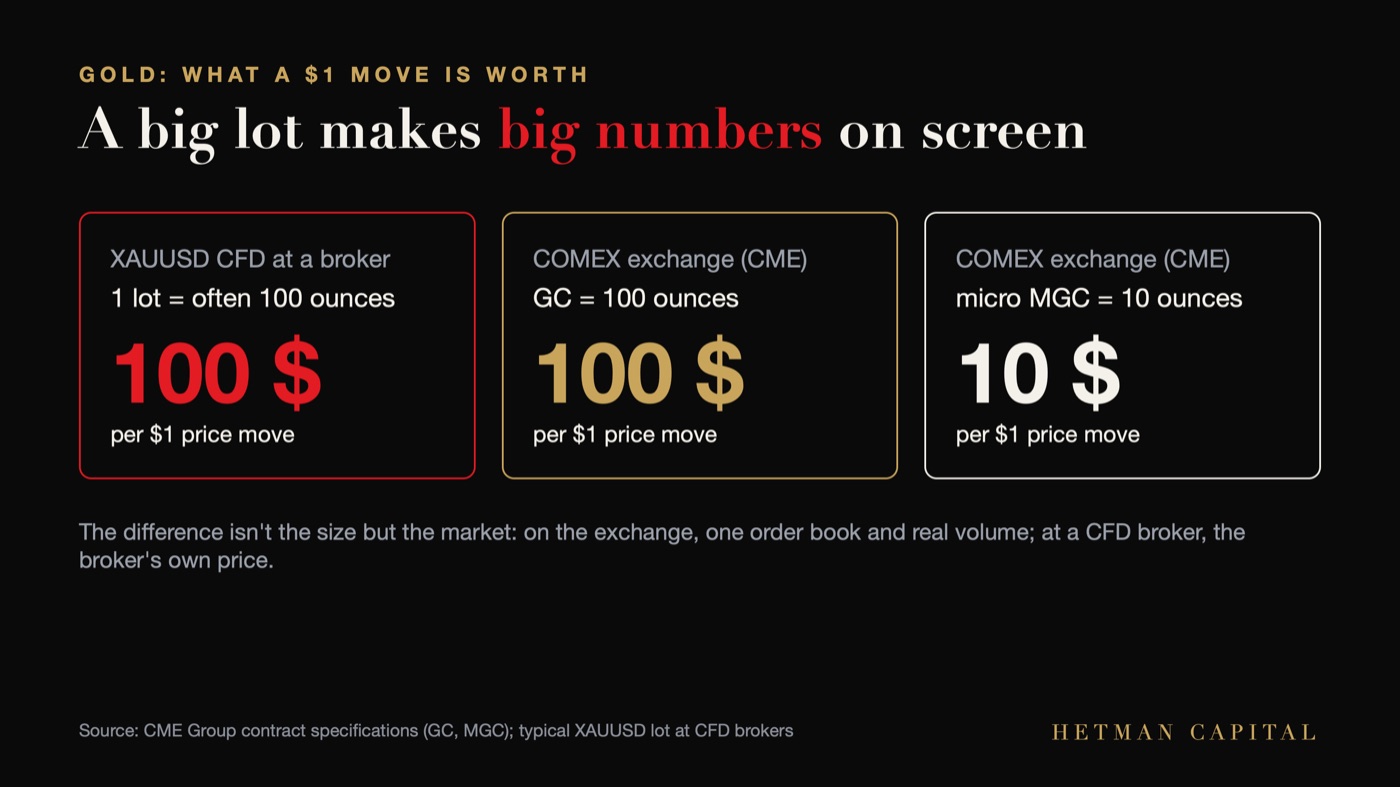
- One “lot” is big. At many brokers 1 lot of XAUUSD is 100 ounces, so a $1 price move means $100 of profit or loss. Signal groups rarely mention this.
How signal sellers make money
I describe the general mechanism of signal groups in the article Trading signals on Telegram, and the bots that invite people into them from the comments in Bots in the comments and live chat. With gold, three models keep recurring:
- Broker commission (an introducing broker, IB). The author gets a share of the fees on every lot traded by people who signed up through their link. They earn from you trading a lot, not from whether you make money. Gold, with a big lot size and frequent signals, generates a lot of volume.
- VIP subscription. The free group shows only the “winning” signals, and the paid one is supposed to be even better. The full track record, including losses, usually can't be verified.
- “Account management”, “loss recovery”, a private account manager. This is where the grey zone ends and the risk of outright fraud begins: a transfer to a “platform” that doesn't exist, or handing over your account login. According to CSIRT KNF, “recover your lost funds” ads are one of the most common themes of fake investment schemes (I describe this in the article KNF warnings and trading).
The legal question: in Poland, a buy or sell recommendation tailored to a specific person is investment advice, which requires a KNF licence. The KNF public warning list contains entries precisely for advice and order-taking without a licence. General education and market analysis are not advice.
10 red flags in “gold” groups
- Someone messages you first after you comment in a chat or under a video.
- The screenshots only show closed profits, never the full account history with dates.
- A signal has several targets (TP1, TP2, TP3) and a wide or “mental” stop. Hitting the first target is announced as a success, even when the rest of the position ends in a loss.
- Losing signals disappear from the channel or get “cancelled” after the fact.
- The group requires you to open an account with a specific broker through a link.
- A promise of steady profit: “20% a month”, “95% accuracy”.
- Time pressure: “last VIP spots”, “price goes up tomorrow”.
- A request for your account login and password, to install remote desktop software or to transfer money to a “technical account”.
- The firm or “platform” isn't in the regulator's registers, or its name impersonates a well-known company.
- Instead of an answer to “why are we entering here?”, you only get levels to copy.
“Live” MetaTrader profits and an Instagram lifestyle
Selling gold signals almost always relies on two kinds of proof: a platform recording (usually MetaTrader) in which XAUUSD positions grow by thousands of dollars in minutes, and photos of an expensive lifestyle. Both can be staged.
- The platform: a demo account presented as real, a cent account (a balance in cents looks 100 times bigger), a “broker” server where the owner types in the balance, or multiple accounts of which only the one currently winning is shown. Gold fits this perfectly: a big lot and big moves produce spectacular numbers on screen. I describe all the mechanisms in the article Fake MetaTrader results.
- The lifestyle: a car rented by the hour, a borrowed or fake watch, an Airbnb villa, a “private jet” in a photo studio and prop money from a film set. I explain how it works in the article The fake luxury of “educators”.
Gold CFDs vs exchange-traded gold
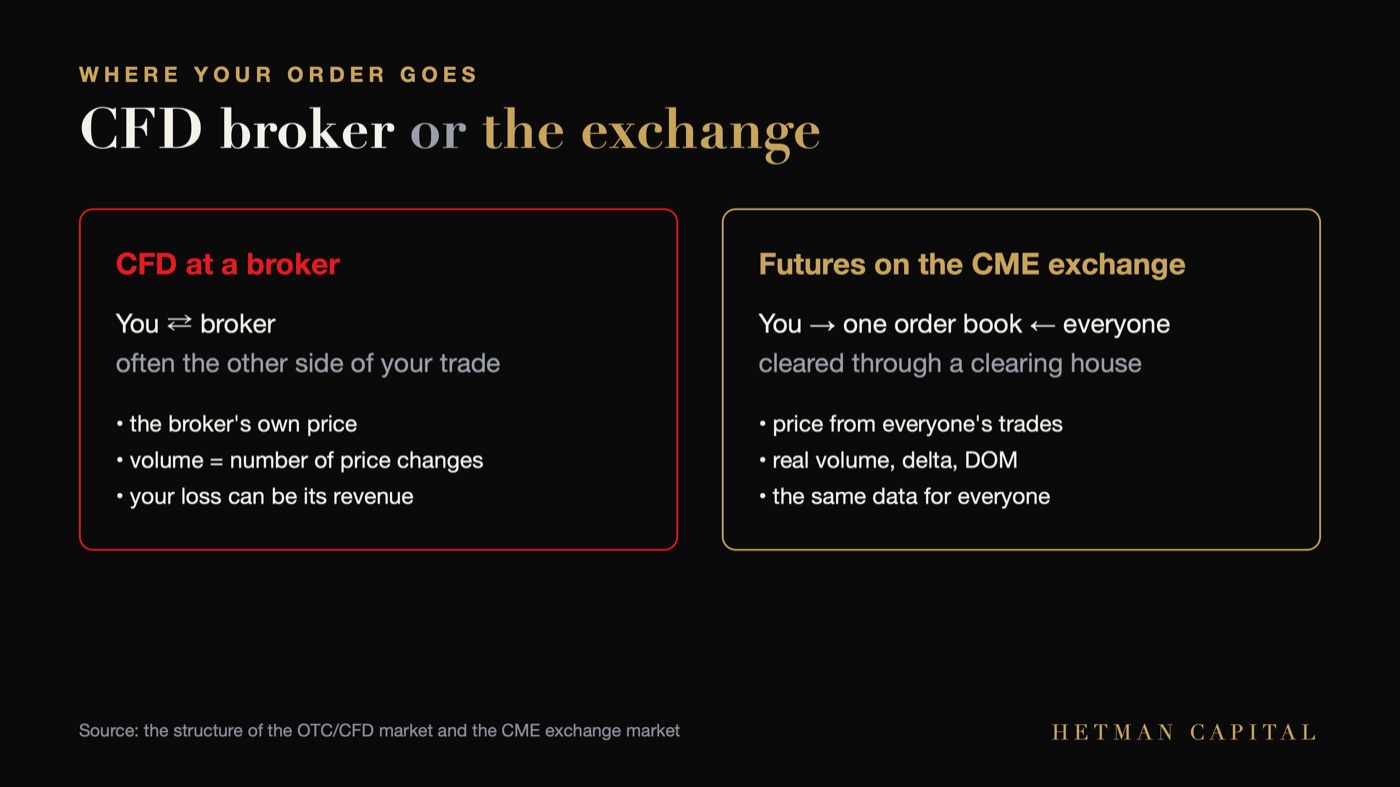
What these groups call “gold” is almost always an XAUUSD CFD at a broker. Gold also has an exchange market: futures on COMEX, part of CME Group. The differences are fundamental:
| XAUUSD CFD at a broker | Gold futures on the CME (COMEX) | |
|---|---|---|
| Where the trade happens | with the broker, off-exchange; with a market-maker broker, the broker is your counterparty | in the exchange's single central order book, cleared through the CME clearing house |
| Price | from the broker's quote | from all market participants' trades |
| Volume | usually just the number of price changes at the broker (tick volume) | every trade from the exchange: volume, delta, footprint, order book |
| Contract size | broker-dependent (often 1 lot = 100 ounces) | GC = 100 ounces, micro MGC = 10 ounces (a $1 move = $10 on MGC) |
| Cost | spread and overnight financing (swap) | commission and exchange fees; the contract has an expiration date |
At about $4,175 an ounce, one micro MGC contract has a notional value of about $41,750. It's still a leveraged, high-risk instrument. The difference is that on an exchange you see the real market: who's buying, who's selling and where the liquidity sits. Without that, a “signal” is just a level with no order flow information behind it.
How I approach this
I trade Dow Jones futures (MYM) on the CME in Chicago, with paid exchange data, trade by trade, in Sierra Chart: order flow, the footprint, the order book and the volume profile. Gold isn't my main market and I don't give signals on it. I don't give them on the Dow Jones either. On the live stream I show how I read the market and why something interests me or doesn't. The decision is always yours.
If gold interests you, start by learning, not by copying. Learn to read the volume profile and VWAP, practise on market replays and keep a journal. I describe the choice between a broker and an exchange in the article Exchange or CFD broker.
Frequently asked questions
Do gold signals work?
Most groups' results can't be verified, because they show selected screenshots rather than a full account history. According to UKNF, 72.2% of active forex/CFD clients lost money in 2025. A signals group doesn't change that statistic.
Are paid trading signals legal in Poland?
Recommendations tailored to a specific person are investment advice, which requires a KNF licence. The KNF adds entities to its public warning list for unlicensed advice and order-taking. General education is not advice.
How is XAUUSD different from a gold futures contract?
XAUUSD is usually a CFD with a broker, priced by the broker. Gold futures (GC, micro MGC) are listed on COMEX in CME Group, with a single order book and real traded volume. Both instruments are leveraged and high-risk.
Someone is messaging me on behalf of Lucas Hetman offering signals. What should I do?
It's a fake. I don't run a signals group, I never send the first private message and I don't ask for money or login details. Don't reply, and report the account on the platform.
Educational content, not an investment recommendation or legal or tax advice. I name firms only to show public data from registers and from their own risk warnings.