Fake MetaTrader results: how people show profits that don't exist

“Watch: +$4,200 on gold, live, in 12 minutes.” Recordings like this from MetaTrader or another platform are the most common proof used to sell signals, courses and “account management”. The platform screen looks credible because it's real software. The problem is that the software alone tells you nothing about whose money it is, whether it exists at all, and what's happening off-screen. Below I describe the recurring mechanisms. I write about them so that you can recognise them, not so that anyone can copy them.
1. A demo account presented as real
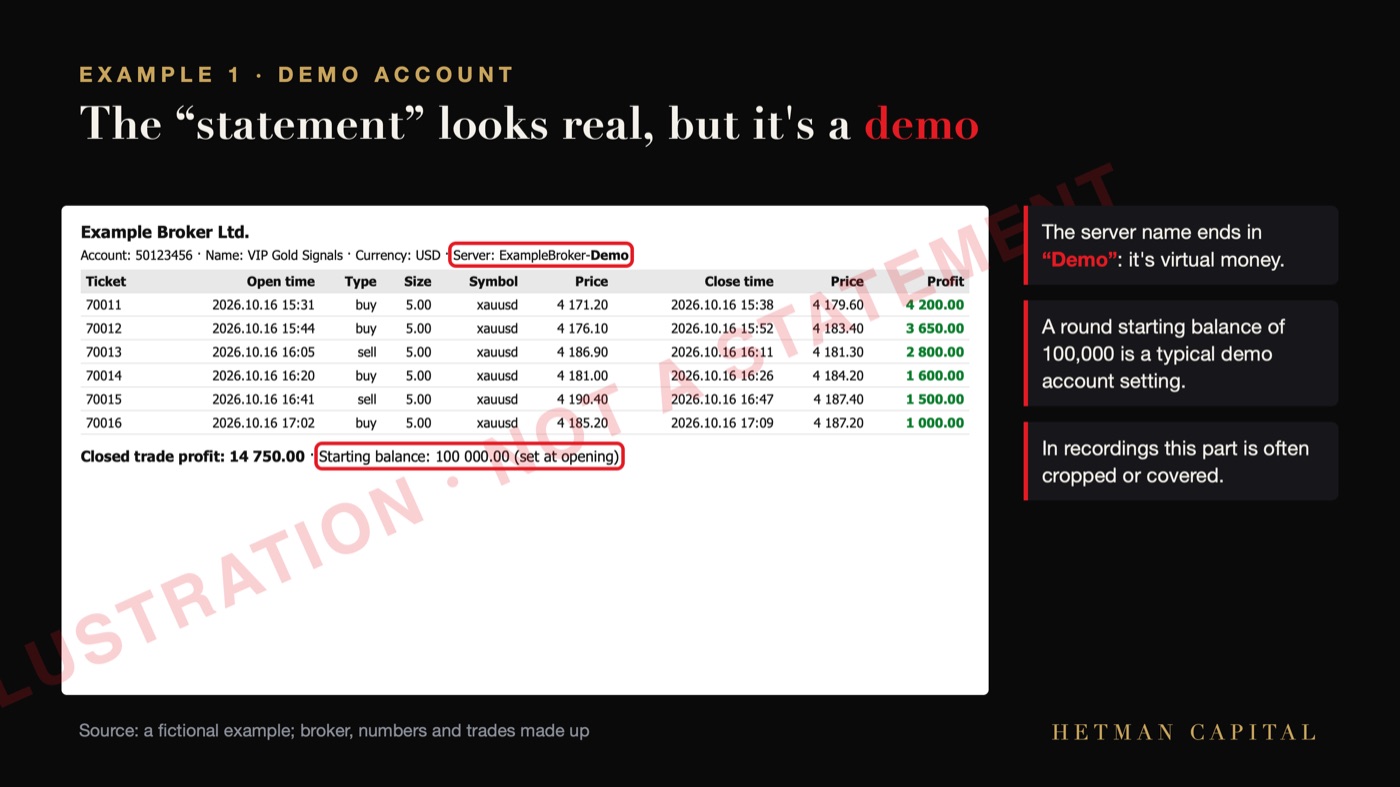
Every broker offers a demo account with virtual money, often with any balance you like, e.g. $100,000. The demo platform looks almost identical to the real one. The difference shows in small places: the word “Demo” in the server or account name, the account type in the account window. In a recording these are easy to cover, crop or keep out of frame.
2. Cent accounts: zeros that mean nothing
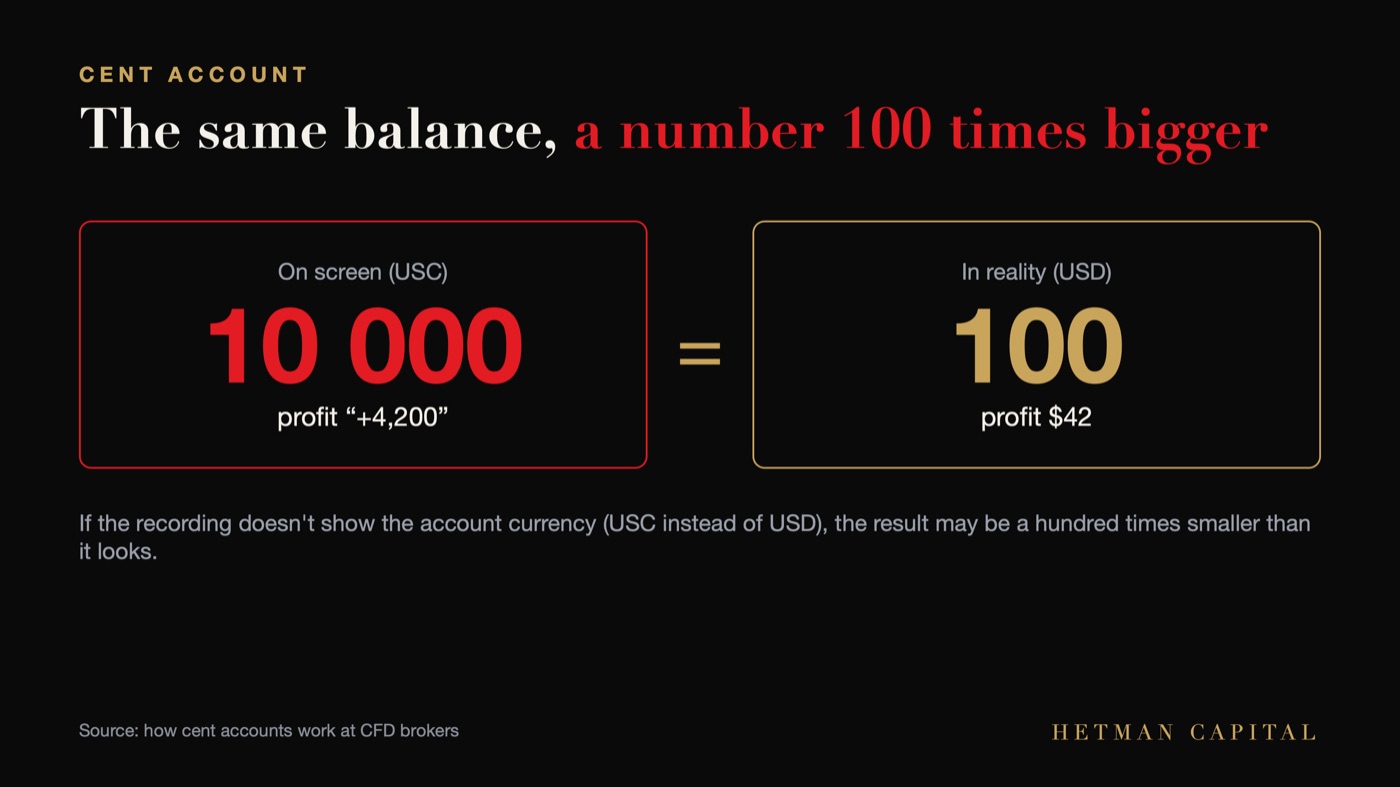
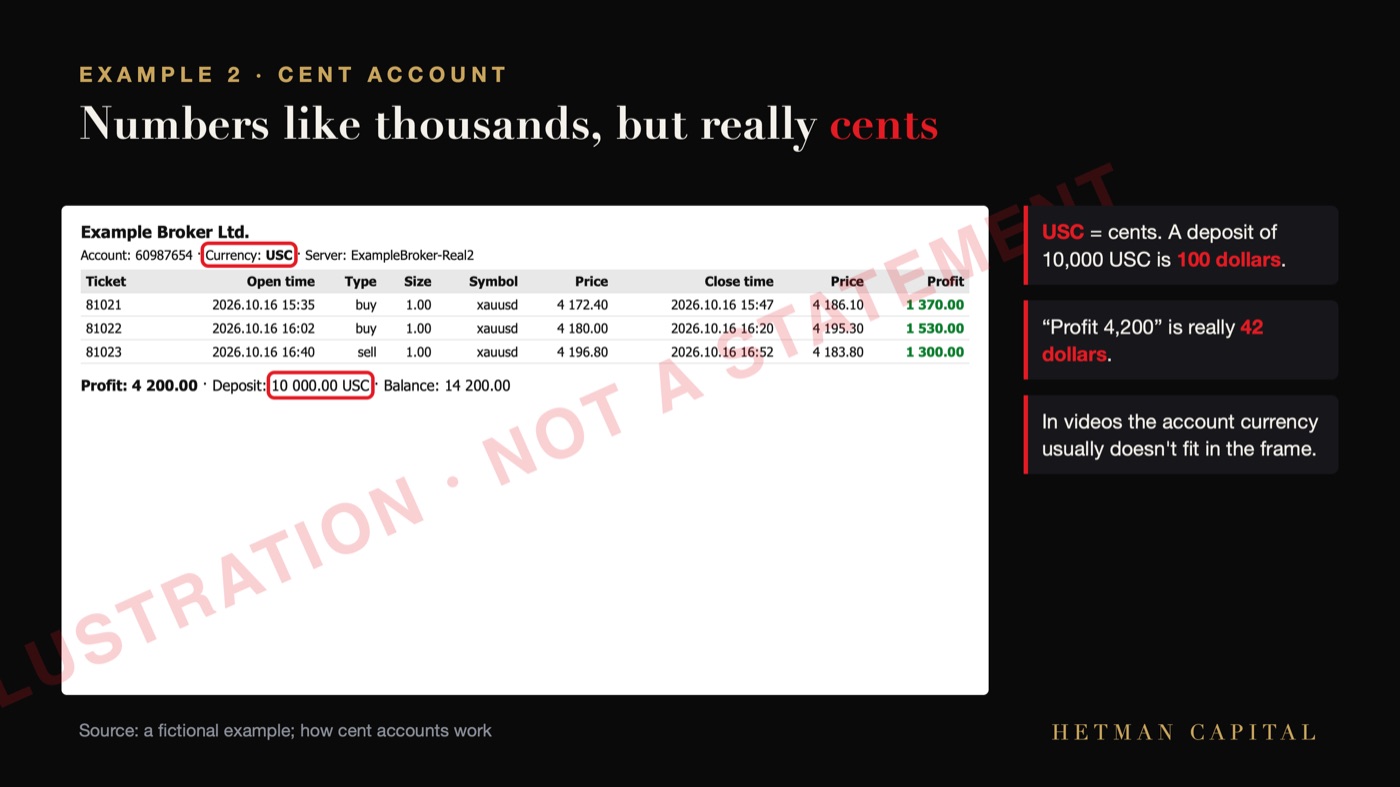
Some brokers offer cent accounts. The balance is shown in cents, so a $100 deposit displays as 10,000. A profit of 4,200 “on screen” is then $42. If the account currency (USC instead of USD) isn't visible in the recording, the numbers may be a hundred times smaller than they suggest.
3. A “broker” who types in the balance
Any company that buys a licence and a server can set up a MetaTrader-type platform. The server owner has an admin panel for managing client accounts. At an honest firm that's an ordinary tool. At a fake “investment platform” it's a way to show the victim a growing balance that can never be withdrawn. CSIRT KNF describes exactly this scheme: the results panel is part of the script, and the “platform” often doesn't exist as a company at all. So the first question isn't “what's the result?” but “which broker, and is it in the register of the KNF or another EU regulator?”.
4. Many accounts, and showing only the winner
Someone opens ten accounts and trades each one differently: buying gold on one, selling on another, using different position sizes on the rest. After a week they show the one that made the most and say nothing about the others. The result is real but says nothing about skill. The “live” variant: two accounts with opposite positions, recording only the one that happens to be winning.
5. Cutting out losses and showing selected fragments
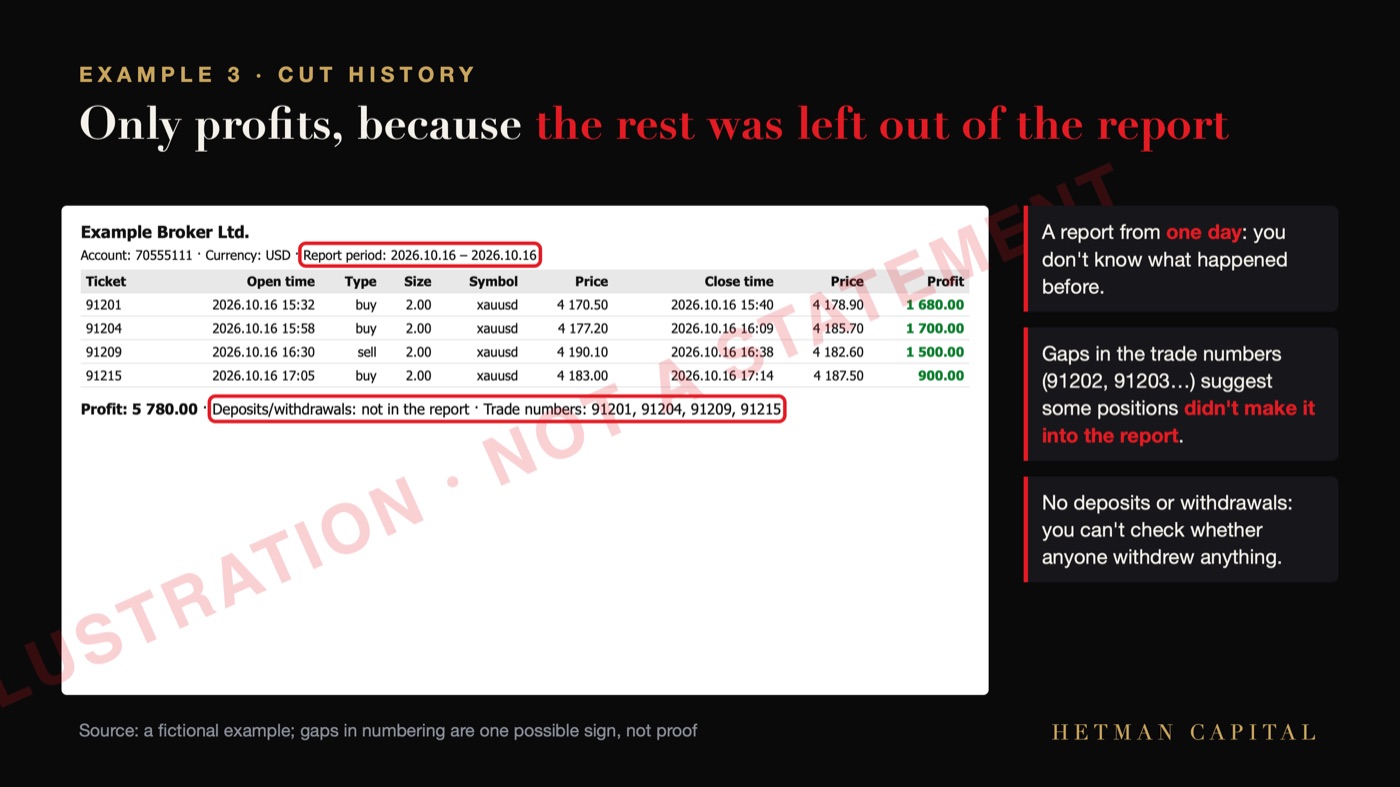
- The recording starts after entering the position and ends before it's closed. You can't see how many times the same “strategy” lost before.
- Account history filtered down to one day or one instrument.
- Screenshots edited in the browser (developer tools let you change any number on a page) or in a graphics program.
- “Platform screenshot” generators and apps that mimic a broker's screen.
6. Why it's usually gold
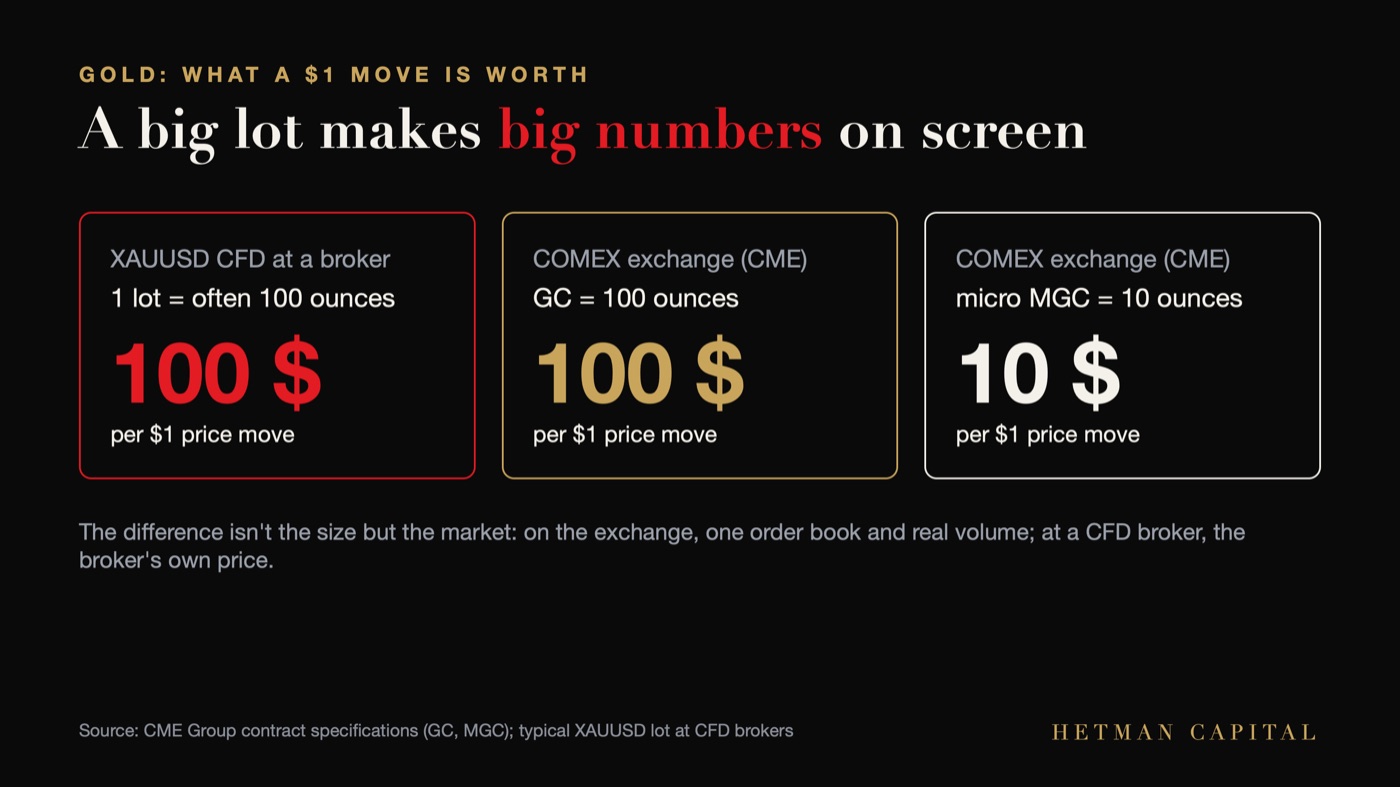
- A big lot: at many brokers 1 lot of XAUUSD is 100 ounces, so a $10 move shows $1,000 on screen. The numbers quickly look impressive.
- Big moves: gold at record highs moves a lot intraday, so you can record “+4,000” in a few minutes.
- Leverage: with high leverage a small deposit becomes a big position (more in the article 1:1000 leverage).
- Recognition: everyone knows what gold is, but few know what XAUUSD at a CFD broker is. I describe the sales mechanism in the article Gold signals.
7. “Verified” results: what verification means
Services that publish account statistics connect to the account with a read-only password (in MetaTrader, the so-called investor password). That limits screenshot editing, but it doesn't solve everything:
- check whether the account is real rather than demo, and with which broker,
- check the length of the history: three good weeks are not proof,
- check the maximum drawdown: a big profit with a huge drawdown is usually high-leverage gambling,
- remember that one verified account doesn't tell you how many other accounts the same person has blown up.
What a credible track record looks like
- A named broker, checked in the KNF register or with another EU regulator.
- A broker statement covering a long period, with deposits, withdrawals and all trades – not a screenshot of one day.
- Withdrawals to a bank account, not “profit on screen”.
- No one is selling you access to that result: neither signals nor an account to be “managed”.
How I approach this
I trade Dow Jones futures (MYM) on the CME in Chicago. On the live stream I show the chart with paid exchange data, trade by trade: the order book, the footprint, the volume. That data can't be “set” from a broker's panel, because it comes from one central order book in which all market participants trade. I don't show account results as an incentive and I don't sell signals. I show how I read the market.
Frequently asked questions
How can I tell a MetaTrader result comes from a demo account?
Look for “Demo” in the server name and account type. It's often hidden in recordings, so only a statement from a registered broker, with deposit and withdrawal history, is credible.
What is a cent account?
An account whose balance is displayed in cents. A $100 deposit shows as 10,000, so profits on screen look a hundred times bigger than they really are.
Is a verified result on a statistics site reliable?
It makes editing screenshots harder, but it doesn't tell you whether the account is real, how long the history is, what the drawdown was, or how many other accounts the same person has lost.
Why do fake results usually involve gold?
Because XAUUSD at a broker has a big lot size (often 100 ounces) and moves a lot, so within minutes thousands of dollars appear on screen, which look good in an ad.
Educational content, not an investment recommendation or legal or tax advice. I name firms only to show public data from registers and from their own risk warnings.